
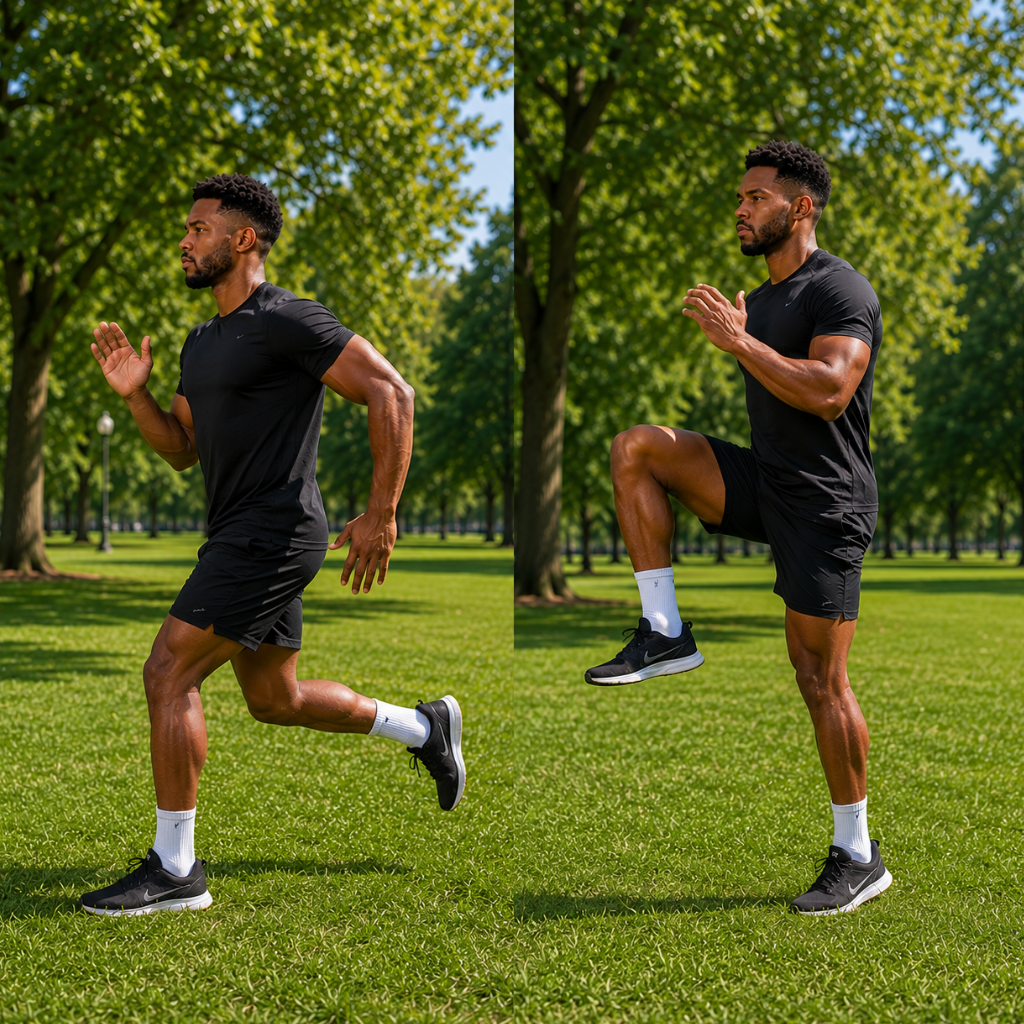

You’ve got two honest options and not much time to spare: ten minutes of HIIT most days of the week, or one or two 60-minute jogs on the weekend. Which one actually makes you fitter? It’s a fair question — and the answer isn’t the one the fitness industry usually sells you. Both work. But for how most people actually live, one of them wins by a wide margin.
The short answer
Neither option is a waste of time. The biggest jump in health and fitness comes from going from nothing to something regular — and both plans clear that bar easily. The World Health Organization recommends adults get 150–300 minutes of moderate or 75–150 minutes of vigorous activity per week, plus two strength sessions (WHO, 2024). Ten focused minutes most days, or a couple of longer jogs, both move you a long way toward that — and toward feeling better.
So the real question isn’t “which is scientifically superior.” It’s “which one will you still be doing in three months?” Let’s break it down honestly.
Round 1: Cardio fitness (VO₂max)
If you care about your heart and lungs, here’s the good news: both win. A well-known meta-analysis found that HIIT and steady endurance training both produce large improvements in VO₂max — the gold-standard measure of aerobic fitness — with HIIT delivering slightly greater gains (Milanović et al., 2015). The kicker: HIIT gets there in a fraction of the time. Minute for minute, short high-intensity intervals are one of the most efficient ways to build cardio fitness we know of.
Edge: HIIT — but only for efficiency. If your goal is specifically to run — a 10K, a trail race, an hour of easy miles — then run. Jogging builds running-specific endurance that ten minutes of squats and burpees won’t fully replicate.
Round 2: Calories and fat loss
Here’s where we cut through the hype. In a single session, a 60-minute jog burns more calories than 10 minutes of HIIT — simple as that, more time moving equals more energy spent. HIIT does create an “afterburn” (your body keeps burning slightly more for a while afterward), and that effect is real. But it’s modest — a small bonus, not a magic multiplier. Anyone selling HIIT as a fat-melting cheat code is overselling it.
The truth about fat loss: it’s driven mostly by your total weekly energy balance and what’s on your plate, not by which workout you pick. Both plans help. Neither replaces the kitchen.
Edge: jogging per session, but it’s close over a full week — and it’s the least important round anyway.
Round 3: The one that actually decides it — consistency
This is where the whole thing tips. The most effective workout isn’t the one with the best study behind it. It’s the one you actually do — again and again, on the tired days, the busy days, the rainy days.
A 10-minute session at home has almost no barriers. No commute to a route, no gear, no shower logistics, no waiting for good weather, no “I’ll need at least an hour so I’ll do it tomorrow.” You press start and you’re done before an excuse can form. A weekend 60-minute jog, by contrast, needs a clear block of time and decent conditions — and the moment life gets busy, it’s the first thing to get cancelled. Miss one weekend and you’ve missed half your training for two weeks.
Short and frequent beats long and occasional — not because the science says so, but because you’ll actually keep showing up. That’s the whole game. If you want a gentle on-ramp, our 5-minute morning workout is built for exactly this.
The honest catch with “daily HIIT”
We won’t pretend there’s no downside. Going all-out at true maximum intensity every single day isn’t smart — your body needs recovery to adapt. But “daily movement” doesn’t mean “daily max-out.” The fix is simple:
- Rotate the focus. Legs one day, push movements the next, core after that — so no single area gets hammered daily.
- Keep some days “hard but controlled.” Not every session has to leave you on the floor. Moving with intent counts.
- Listen to the real signals. Poor sleep, a stubbornly high resting heart rate, or dread instead of motivation means take it easy or rest. That’s not weakness — it’s how progress works.
Stop planning. Start moving.
GreenReps guides you through short bodyweight workouts — from 10 to 60 minutes, whatever your day allows. No gym, no equipment. Just press start.
So which should you choose?
- Love running, training for a race, or crave an hour outside? Jog. Keep it. It’s good for your body and your head.
- Time-starved, tired of fitness eating your life, and struggling to stay consistent? Ten minutes of HIIT most days is your answer — it’s built for the way you actually live.
- Want the best of both? You don’t have to pick a team. Three or four short HIIT sessions during the week plus one easy weekend jog is a genuinely excellent combination — dense fitness on busy days, plus the calm and endurance of a longer run when you have the time.
In short
- Both work — the biggest gains come from doing something regularly.
- HIIT wins on time-efficient cardio fitness; jogging wins per-session calories; fat loss is mostly diet.
- Consistency is the real tiebreaker — and 10 minutes a day is far easier to keep than a weekend hour.
- Don’t max out daily: rotate focus, respect recovery.
- Best plan for most: short sessions on weekdays + one easy jog when you can.
Ready to build a habit that survives a busy week? A 30-day challenge is a simple way to prove to yourself that ten minutes a day adds up fast.
Frequently asked questions
For general fitness and health, yes — especially compared to the far more common alternative of doing nothing. Ten focused minutes most days builds real cardio fitness and strength. If your goal is a specific athletic result, like running a marathon, you’ll want to add sport-specific training on top. But as a foundation of consistent fitness, it’s plenty.
You can move every day, but you shouldn’t go all-out at maximum intensity every day. Rotate which muscle groups you target, keep some sessions moderate, and take a genuine rest day when your body signals it needs one (bad sleep, elevated resting heart rate, low motivation). Daily consistency is great; daily exhaustion is not.
A 60-minute jog burns more calories in that single session. HIIT adds a small “afterburn” effect, but it’s modest and doesn’t close the gap on its own. Over a full week the two can even out depending on how often you train. Ultimately, fat loss depends far more on your overall diet and weekly energy balance than on which workout you choose.
It can be, because you control the movements. Bodyweight HIIT lets you swap high-impact moves (like jump squats) for low-impact versions (like step-backs or marches), which is harder to do while running. That said, plyometric HIIT can also stress joints — so scale the moves to your body. Neither option is automatically “safe” or “risky”; how you do it matters more than which you pick.
Absolutely — and for most people it’s the ideal setup. Do three or four short HIIT sessions during the week for time-efficient fitness and strength, then add one longer, easy-paced jog on the weekend for endurance and headspace. You get the benefits of both without either one taking over your schedule.