
Burpees might be the most effective exercise you can do with nothing but a bit of floor space and your own body. A single burpee works your legs, chest, arms and core — and spikes your heart rate in seconds. That’s exactly why they’re perfect when time is short.
The catch: with poor form your back complains and the benefit fades. In this guide you’ll learn the clean movement, the most common mistakes, and a beginner-friendly version in case the full one is too much for now.
Which muscles do burpees work?
Burpees are a full-body move. In a single rep you train:
- Legs & glutes (the squat and the jump)
- Chest, shoulders, triceps (the push-up phase)
- Core (stability in the plank)
- Cardiovascular system (thanks to the pace)
That’s why burpees are one of the most time-efficient exercises out there: a lot of effect in very little time.
Burpees step by step
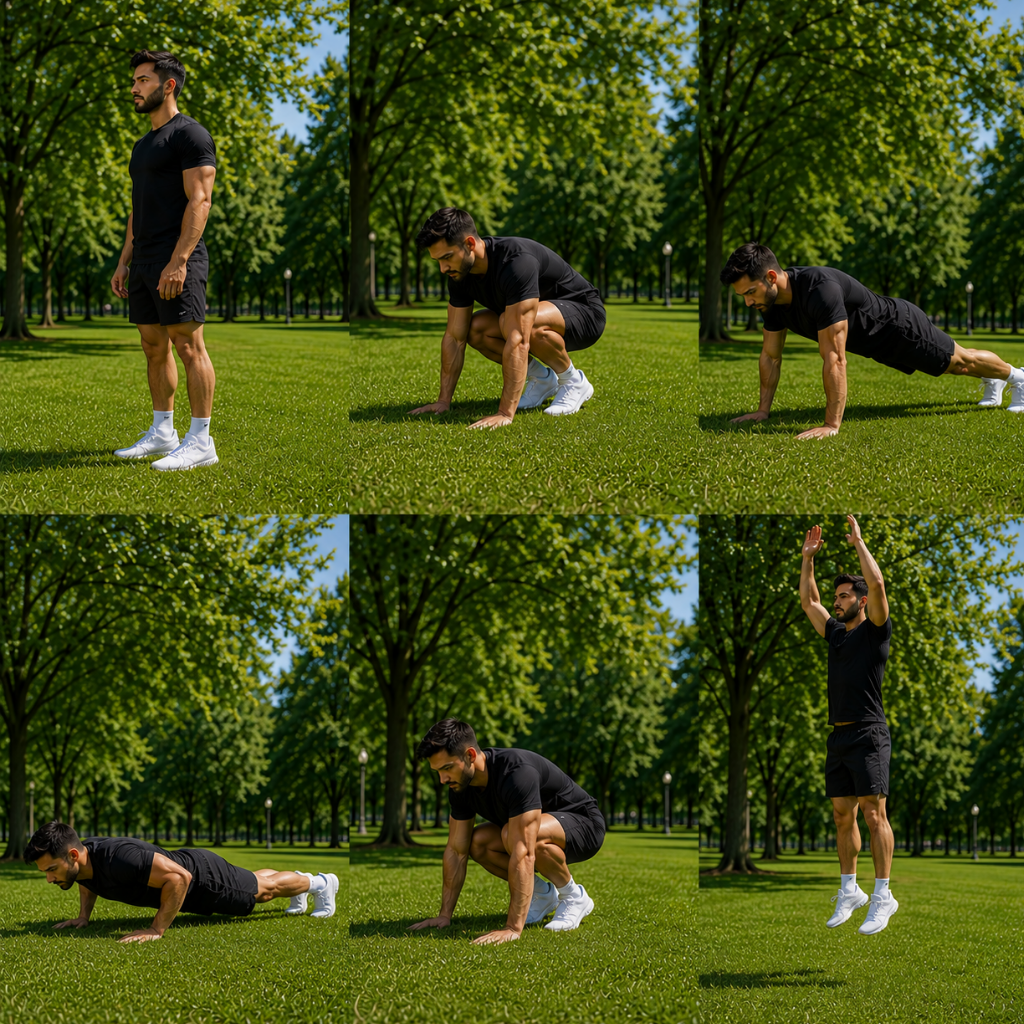
- Starting position: Stand tall, feet shoulder-width apart, arms relaxed.
- Drop into a squat: Bend your knees and place your hands on the floor, shoulder-width apart.
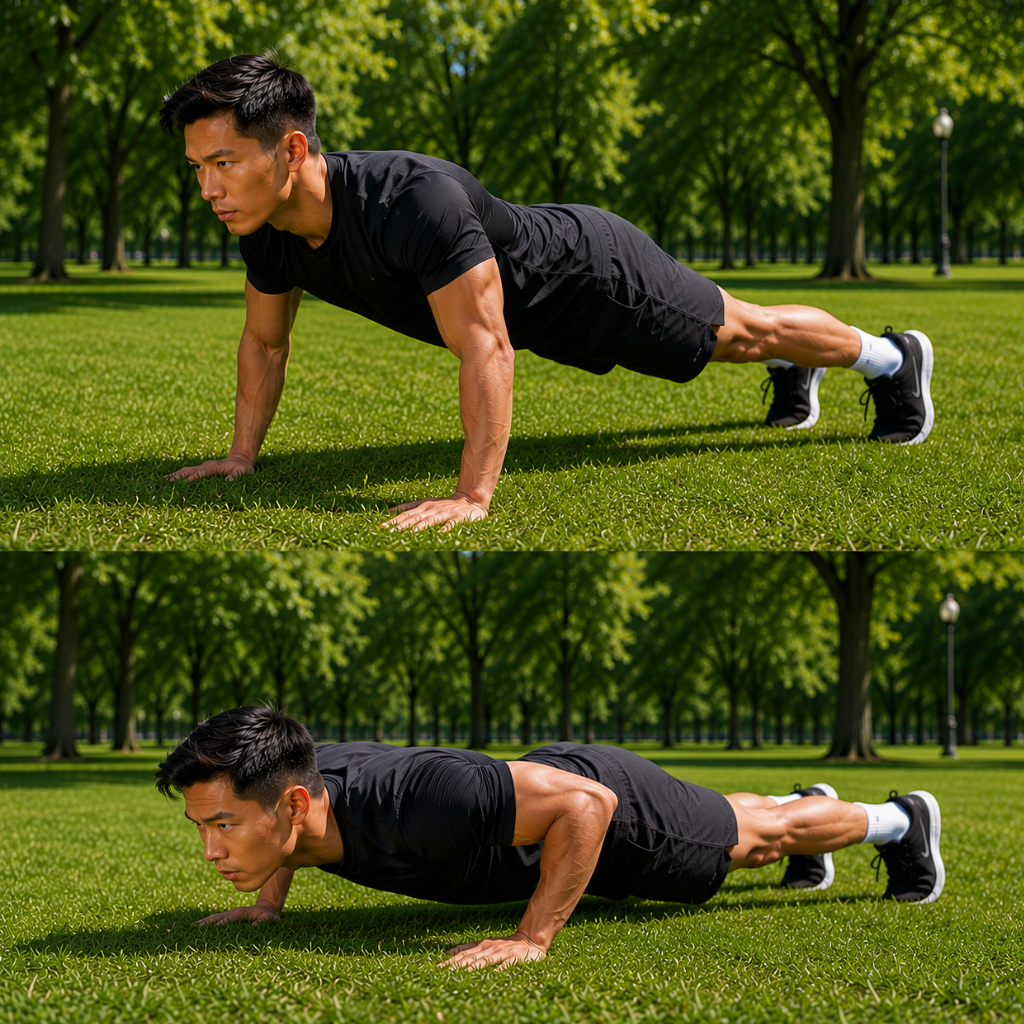
- Kick the legs back: Jump (or step, controlled) into a plank — body in a straight line, core tight.
- Push-up (optional): Lower your chest toward the floor under control, then press back up.
- Return to squat: Jump or step your feet back between your hands.
- Jump up: Explode upward, arms overhead. Land softly — that’s one rep.
Guided reps, zero guesswork.
GreenReps guides you through short bodyweight workouts — from 10 to 60 minutes, whatever your day allows. No gym, no equipment. Just press start.
The 5 most common mistakes
- Sagging back in the plank. The lower back drops → brace your core and keep the body in one line.
- Speed over form. Clean, slightly slower reps beat rushed, half ones.
- Hard landing. Land softly with bent knees to protect your joints.
- Hands too narrow or too wide. Shoulder-width keeps shoulders and wrists stable.
- Forgetting to breathe. Exhale on the jump, inhale on the way down — it keeps you going longer.
Too tough? The beginner version
Drop the demanding parts first:
- No jump: Instead of jumping up, simply stand up firmly onto your toes.
- No push-up: Hold the plank and come straight back to the squat.
- Step instead of jump: Step the legs back and forward one at a time.
This builds strength and conditioning until the full version feels easy.
How often should you do burpees?
To start, 3 rounds of 30–45 seconds with a short break is plenty — that’s under 5 minutes. More important than volume is consistency: a few minutes daily beats one exhausting session a week.
In short
- Burpees are a full-body, no-equipment exercise — perfect for a busy schedule.
- Clean form protects your back and maximizes the effect.
- Beginners skip the jump and push-up and build up slowly.
- Consistency beats intensity.
Ready for your first session? With GreenReps you start in 60 seconds — the timer counts, you just do the burpees.
Frequently asked questions
Yes — with the right version. Start with the no-jump variation: step back into the plank instead of jumping, skip the push-up if needed, and stand up rather than leaping. Once that feels smooth, add the jump and push-up. Burpees scale to any level.
There is no magic number. Beginners can start with 3–5 sets of 5 reps, or simply as many as you can do with clean form in a short interval. Consistency matters far more than a high count — a few good burpees daily beats an exhausting session you dread repeating.
Almost all of them. A single burpee hits your legs (squat and jump), chest, shoulders and arms (push-up), and core (plank), while your heart and lungs work hard throughout. That full-body demand is why burpees are so time-efficient.
They build muscular endurance and can add some strength, especially for beginners. For maximal muscle size you will need progressive resistance training. Think of burpees as a superb conditioning and full-body fitness tool rather than a pure muscle-building exercise.
Not when done with control. Land softly with bent knees, keep your core braced so your lower back does not sag in the plank, and move at a pace you can keep clean. If you have joint issues, use the low-impact no-jump version and skip the explosive parts.