
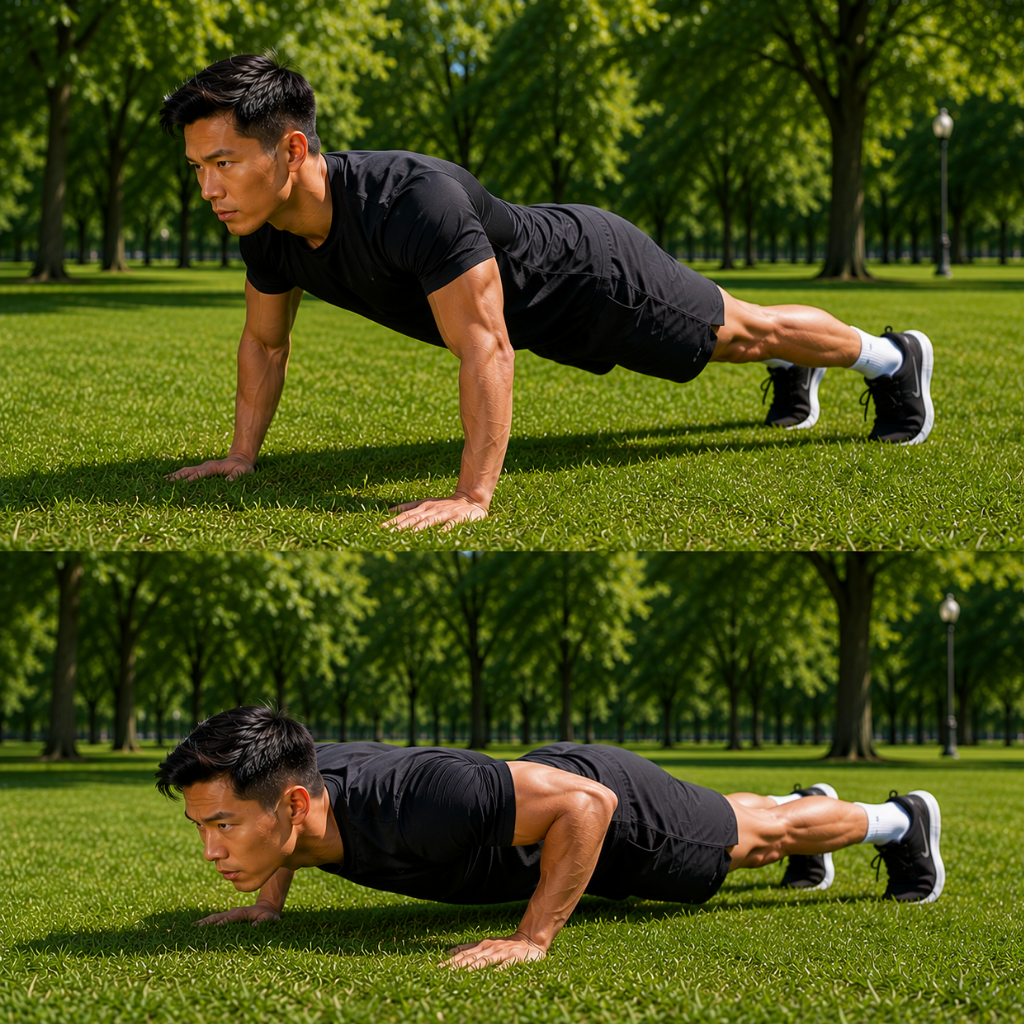
Every rep you do is made of three moments: you push, you lower, you hold. Those are the three basic types of muscle contraction — concentric, eccentric and isometric — and each one does something slightly different for your body. Once you understand them, a plain push-up turns into three different exercises, and you can steer your training toward strength, muscle, control or joint health without a single piece of equipment. Here’s the calm, no-hype version of what each contraction type is, what it’s good for, and where its limits are.
What a muscle contraction actually is
A contraction is simply your muscle producing force. Whether the muscle gets shorter, longer or stays the same length while it does that depends on one thing: is the force you produce bigger, smaller or equal to the load you’re working against? That gives you the three basic types. Everything else — isotonic, plyometric, isokinetic — is a combination or a special case of these three.
Concentric: the muscle shortens
This is the part most people think of as “the exercise”: pressing up from a push-up, standing up from a squat, pulling yourself up to the bar. Your muscle produces more force than the load, so it shortens and the joint moves.
- Good for: building power and speed, learning technique, and the part of training that simply feels like progress. Concentric work causes the least soreness of the three, so you recover fast.
- The catch: you’re at your weakest concentrically. You can lower more than you can lift, so if you only ever count the “up” phase, you leave a lot of stimulus on the floor. And rushing it turns a strength exercise into a bounce.
- Bodyweight examples: the push in a push-up, the drive out of the bottom of a squat, the jump in a burpee.
Eccentric: the muscle lengthens under load
Eccentric is the lowering phase — the muscle is producing force but the load wins, so it lengthens while braking. Lowering into a push-up, sitting down into a squat, coming down from a pull-up slowly. It’s the phase almost everyone skips, and it’s the one with the most untapped potential.
Your muscles are noticeably stronger eccentrically than concentrically — you can lower roughly 20 to 50 percent more than you can lift. That’s why “negatives” are the classic back door to exercises you can’t do yet: if you can’t do a pull-up, you can still lower yourself from the top in five slow seconds, and that’s a real training stimulus. The research backs the effort: a systematic review in Sports Medicine found that eccentric training produces greater strength gains than traditional training and is a particularly potent stimulus for the muscle-tendon unit (Douglas et al., 2017). For muscle growth, a meta-analysis by Schoenfeld and colleagues found a small edge for eccentric over concentric actions — roughly 10 versus 7 percent growth — while stressing that both matter (Schoenfeld et al., 2017).
- Good for: unlocking hard exercises (pull-ups, pistol squats, handstand push-ups), building muscle, and making tendons more robust.
- The catch: eccentric work is what makes you sore two days later. It needs more recovery than it feels like in the moment, so don’t add slow negatives to every exercise in every session. And “lowering” only counts if you control it — dropping is not eccentric training.
- Bodyweight examples: 3-to-5-second lowering in push-ups and squats, negative pull-ups, slow step-downs from a bench.
Isometric: the muscle holds
Two kinds of isometric
Isometric means force without movement: your muscle works, the joint angle stays where it is. Plank, wall sit, dead hang, the pause at the bottom of a squat. There are two flavours. In a yielding isometric you hold a position against gravity and try not to give in — the plank, the wall sit. In an overcoming isometric you push or pull as hard as you can against something that won’t move — pressing your palms against a door frame, pulling on a bar that’s bolted down. Yielding holds train endurance and control; overcoming holds let you produce near-maximal force with almost no joint stress.
What isometrics are good for
Isometrics are the most underrated tool in bodyweight training, for three reasons. First, they’re joint-friendly: no momentum, no impact, and you decide exactly how hard to push. Second, they build strength precisely where you need it — hold the bottom of a push-up for a few seconds and your sticking point stops being a sticking point. Third, they’re quiet, need zero space and work anywhere, which fits a training life without a gym rather well.
There’s also a health angle that surprised a lot of people: in a large network meta-analysis of 270 trials in the British Journal of Sports Medicine, isometric exercise training came out as the most effective exercise mode for lowering resting blood pressure — ahead of aerobic training, HIIT and dynamic resistance training — with the isometric wall squat as the single most effective exercise (Edwards et al., 2023). A few two-minute wall sits a week is a very low bar for that kind of return.
- Good for: joint-friendly strength, fixing weak points in a movement, core and grip endurance, tendon health, and blood pressure.
- The catch: the strength you gain is fairly angle-specific — you get strong mainly around the position you hold, give or take about 15 degrees. A systematic review found that holds at longer muscle lengths (deeper positions) produce more muscle growth and transfer better to real movement, and that you need fairly hard contractions — around 70 percent of your maximum or more — to change tendon properties (Oranchuk et al., 2019). Also: don’t hold your breath. Breath-holding during a hard hold spikes blood pressure sharply in the moment. Breathe steadily and keep the hold to a few seconds if you have any cardiovascular condition — and ask your doctor first.
- Bodyweight examples: plank, side plank, hollow hold, wall sit, dead hang, the pause at the bottom of a squat or push-up, pressing against a wall.
Push, lower, hold — anywhere.
GreenReps guides you through short bodyweight workouts — from 10 to 60 minutes, whatever your day allows. No gym, no equipment. Just press start.
Isotonic, auxotonic, isokinetic — the textbook terms
You’ll run into these words, so here’s the short version. Isotonic is the textbook name for a normal dynamic rep — concentric plus eccentric — under a load that stays “the same” (a dumbbell). Strictly speaking, almost nothing in real life is isotonic, because the tension in your muscle changes as the leverage changes through the range. That’s why the more precise term for bodyweight training is auxotonic: tension varies during the movement, which is exactly what happens in a push-up or squat — hardest near the bottom, easiest near the top. Isokinetic means constant speed through the whole range and only exists on special machines you’ll find in rehab clinics and labs. Nice to know, irrelevant for training on a patch of grass.
Plyometric: the fast switch from lengthening to shortening
Plyometric training isn’t a fourth contraction type but a way of chaining two: a quick eccentric loading followed immediately by an explosive concentric push. Jump squats, clap push-ups, bounding, the hop out of a burpee. The rapid stretch stores elastic energy in your muscles and tendons and lets you produce more force than a slow rep — the so-called stretch-shortening cycle.
- Good for: power, speed, reactive tendon stiffness, and workouts that feel athletic rather than grinding. A short block of jump squats does more for your heart rate than a long set of slow ones.
- The catch: impact. Plyometrics load your joints and tendons hard, so they’re for people who already have a base of strength and clean technique — and never in high volumes when you’re tired. If your landings get loud, you’re done for the day.
- Bodyweight examples: jump squats, clap push-ups, jump lunges, skipping — and the pace of a HIIT session if you’re wondering how often you should do them.
At a glance: which contraction type for what
| Type | What happens | Best for | Watch out for |
|---|---|---|---|
| Concentric | Muscle shortens, you push or pull | Power, speed, technique, fast recovery | Your weakest phase; easy to rush |
| Eccentric | Muscle lengthens under load, you lower | Muscle growth, unlocking hard moves, tendon strength | Soreness, needs recovery, only counts if controlled |
| Isometric | Force without movement, you hold | Joint-friendly strength, weak points, core, blood pressure | Angle-specific gains, don’t hold your breath |
| Plyometric | Fast eccentric → explosive concentric | Power, athleticism, heart rate | High impact, needs a strength base |
How to use all of this in a bodyweight workout
You don’t need separate “isometric days” or a new program. The simplest tool is tempo: give each phase of a rep a number of seconds. A push-up at “3-1-1” means three seconds lowering, a one-second pause at the bottom, one second pressing up — eccentric, isometric, concentric, all in one rep. Most people who plateau on push-ups or squats aren’t lacking strength. They’re lacking the slow and the still parts of the movement.
A few rules of thumb that hold up:
- Stuck on an exercise? Go eccentric. Five-second negatives, three to five reps, two or three times a week.
- Joints complaining, or you want to train quietly? Go isometric. Deep holds — bottom of the squat, low plank, dead hang — for 20 to 45 seconds, breathing the whole time.
- Want to feel fast and get your heart rate up? Add a short plyometric block when you’re fresh, not at the end.
- Building the habit? Just do clean concentric reps with a controlled lowering. Consistency beats cleverness. Something like our 5-minute morning workout covers all three contraction types without you having to think about it.
In short
- Concentric = push, eccentric = lower, isometric = hold. Every rep contains all three.
- Eccentric work is your strongest phase and the fastest way to unlock exercises you can’t do yet — but it makes you sore.
- Isometrics are joint-friendly, fix weak points, and are the most effective exercise mode for lowering blood pressure — hold deep positions and keep breathing.
- Plyometrics build power but need a strength base and fresh legs.
- You don’t need new exercises. Change the tempo of the ones you already do.
Want to put it into practice with one exercise? Our guide on burpee mistakes shows how sloppy lowering and skipped pauses quietly wreck a great movement — and how to fix them.
Frequently asked questions
Yes, to a point. Research shows isometric training produces real muscle growth and strength gains, especially when you hold positions at longer muscle lengths — deep in a squat rather than near the top — and push fairly hard. The limitation is that the strength you gain is fairly specific to the angle you hold, and it transfers less well to fast, dynamic movement. For most people, isometrics work best as a supplement to normal reps, not a replacement.
Slightly. A 2017 meta-analysis found eccentric-only training produced a bit more growth than concentric-only training, roughly 10 versus 7 percent, but the difference wasn’t dramatic and both phases contribute. The practical takeaway isn’t to train eccentric-only — it’s to stop skipping the lowering phase. Controlling the way down in your normal reps captures most of the benefit with none of the complexity.
Start with normal dynamic reps — concentric plus a controlled eccentric — and add simple isometric holds like planks and wall sits. Both are low-risk, easy to learn and easy to do anywhere. Slow negatives are the next tool once you’re consistent, because they cause more soreness. Plyometrics come last: they need a base of strength and clean technique before the impact is worth it.
The evidence is strong. A 2023 network meta-analysis of 270 randomised trials in the British Journal of Sports Medicine ranked isometric exercise training as the most effective exercise mode for reducing resting blood pressure, ahead of aerobic exercise, HIIT and weight training, with the wall squat as the single most effective exercise. Typical protocols use several two-minute holds with short rests, a few times a week. Two important notes: keep breathing during the hold, and if you have high blood pressure or a heart condition, talk to your doctor before you start.
It depends on the goal. For strength at a specific position, short and hard: 3 to 10 seconds at high effort, several times. For core and postural endurance, moderate holds of 20 to 45 seconds with good form beat a shaky two-minute plank. For blood pressure protocols, the studied format is around two minutes at a moderate effort with rests in between. Whatever the length, stop when your form breaks — a hold you can’t keep clean isn’t training the thing you wanted.